
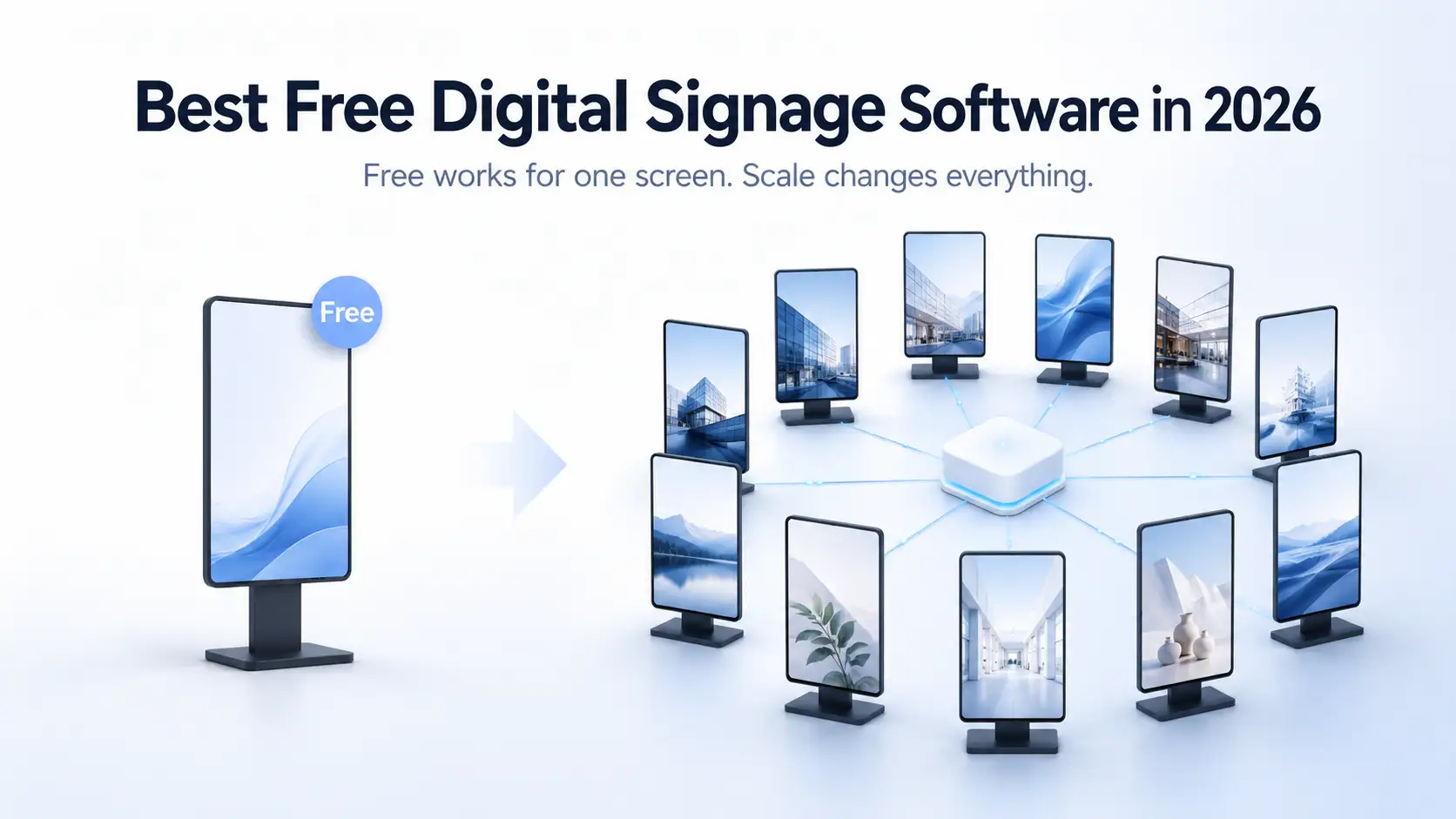
Free digital signage plans compared (verified July 2026)
| Platform | Free tier | The catch |
|---|---|---|
| Yodeck | 1 screen, free forever | Advanced scheduling requires $12/screen Premium; multi-site workspaces $16 Enterprise; no Apple TV |
| OptiSigns | Up to 3 screens | 25MB file limit, OptiSigns branding on screen, limited device support |
| PosterBooking | Up to 10 screens | Watermarks on free screens (per third-party reviews); own pricing page unstable during our July 2026 check |
| Kitcast | No free tier | 14-day Pro trial, no credit card; paid from $7/screen/mo with offline playback on all plans |
Verified July 2026 – free-tier terms change frequently, confirm before deploying.
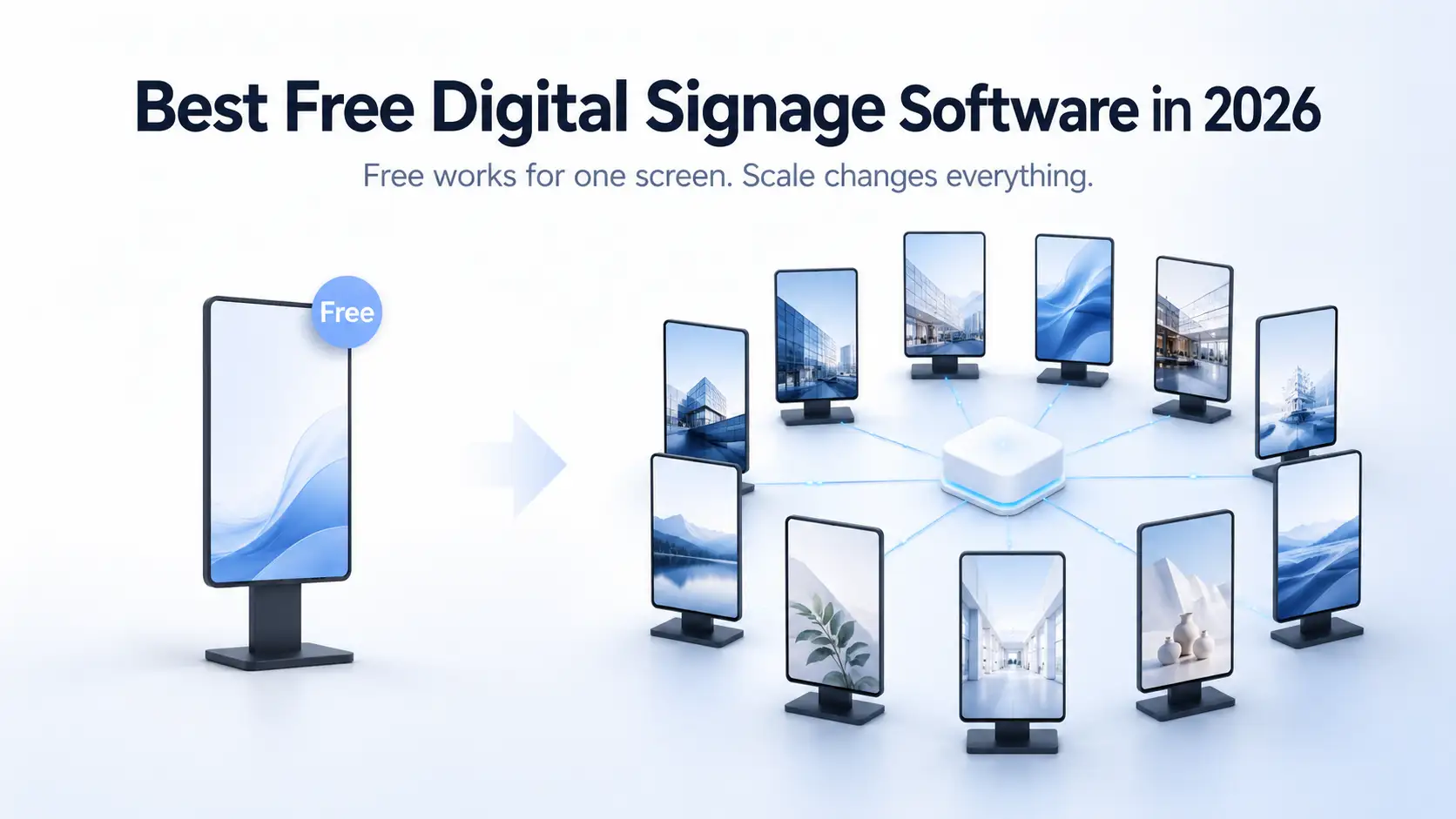
Most teams searching for free digital signage software are in one of two situations: they are testing before they buy, or they are running a single screen and genuinely do not need more. Both are valid starting points.
What rarely gets covered honestly is what happens at screen two, screen ten, or screen fifty. Free tiers exist for a reason, and that reason is not to help you manage a 40-screen office. They are conversion funnels designed to get you into a platform and move you toward paid. For a paid-tier roundup tailored to small business specifically, see our digital signage for small business comparison.
This guide covers every meaningful free plan available in 2026, what each one actually includes, and the exact threshold where a paid plan at $7/screen/month becomes the smarter financial decision. No vendor-sponsored rankings. Just the numbers.
What Is Free Digital Signage Software?
Free digital signage software is a cloud-based content management system (CMS) that lets you push images, videos, and live data to screens without paying a monthly subscription. The word "free" covers three different models, and they are not equivalent. For the broader trends shaping signage in 2026 — AI, mega-installations, programmatic DOOH — see our digital signage trends 2026 report.
Permanently free tier. One screen you can run indefinitely with a limited or full feature set. Yodeck and OptiSigns both offer this. Yodeck's free plan is the stronger of the two: you get the same features as the paid tier, just capped at one screen. OptiSigns' free plan restricts access to most of its 100+ app integrations.
Free trial. Full or near-full feature access for a fixed period before billing begins. Kitcast offers 14 days with complete Pro feature access and no credit card required. This is not a permanent free plan, but it is the most useful starting point if you want to evaluate multi-screen management, SSO, and MDM integration before committing.
Free hardware bundled with a subscription. Yodeck includes a free Raspberry Pi player with annual paid plans. This is not free software. It is deferred hardware cost built into the subscription price. The hardware belongs to Yodeck; if you cancel, you return it.
The core components of any digital signage setup are the same regardless of pricing tier: a display (any commercial TV), a media player (Apple TV, Android box, Fire TV Stick, or BrightSign), and a CMS. Free plans typically cover the CMS cost only. You still pay for hardware, networking, and installation. For a head-to-head on the two most common cheap players, see our apple tv vs fire tv comparison.
For a broader overview of how digital signage software works across hardware types, see what digital signage software is and how it compares.
Which Free Digital Signage Software Plans Are Worth Using in 2026?
Three platforms have genuinely usable free options. Here is what each one delivers, without the marketing language.
| Platform | Free Plan Type | Screen Limit | Apple TV Support | Starting Paid Price |
|---|---|---|---|---|
| Yodeck | Permanent free tier | 1 screen | No | $8/screen/mo |
| OptiSigns | Permanent free tier | 1 screen | No | ~$9/screen/mo |
| Kitcast | 14-day free trial | Unlimited during trial | Yes (native app) | $7/screen/mo |
| Rise Vision | Trial only | N/A | Browser-based | $9.99/screen/mo |
Yodeck -- one screen, free forever
Yodeck's free plan covers one screen permanently and includes the same features as whichever paid tier you are comparing it to. For a single lobby TV, a break room display, or a test deployment, it works exactly as advertised. The catch: add a second screen and all screens, including the previously free one, switch to paid at $8/screen/month. Yodeck runs on Raspberry Pi, Android, Fire TV, and Windows. It does not support Apple TV.
OptiSigns -- one screen, limited features
OptiSigns offers a permanent free plan for one screen, but most of the integrations that make OptiSigns useful are behind a paywall. If you only need basic image and video playback, the free plan functions. If you want Google Slides, social media feeds, or live data, you need a paid plan starting at roughly $9/screen/month. Hardware support is broad: Fire TV, Android, Windows, and Chrome OS.
Kitcast -- 14-day trial, full Pro access, no credit card
Kitcast does not have a permanent free tier. What it offers is a 14-day trial with complete access to Pro features: SSO, API, SCIM, audit logs, MDM integration, offline caching, and all 500+ templates. If you are evaluating whether a platform can handle your real workload before you pay for it, this is the most feature-complete trial in the market. Paid plans start at $7/screen/month on the Starter tier. Kitcast supports Apple TV, Android, Fire TV, BrightSign, LG WebOS, Samsung Tizen, ChromeOS, macOS, and iOS. For corporate teams specifically — offices, lobbies, and video walls — see our corporate signage roundup.
For a direct feature and pricing comparison between Yodeck's free tier and Kitcast's paid plans, see Kitcast vs Yodeck.
Why Does Free Digital Signage Software Get Expensive When You Scale?
Free digital signage gets expensive through four mechanisms. Each one is predictable. None of them appear on the free plan landing pages.
The second-screen trigger
Yodeck and OptiSigns both cap their free plans at one screen. The moment you add a second display, billing applies to every screen in your account, including the one that was free. At Yodeck Basic rates, two screens cost $16/month. At Kitcast Starter rates, two screens cost $14/month. At that scale, the "free" advantage has already evaporated, and Kitcast is cheaper.
Missing governance features
Free tiers strip out the features IT teams require for any real deployment. SSO (single sign-on) so staff authenticate with company credentials, SCIM for automated user provisioning when employees join or leave, and audit logs for compliance reviews are absent on every free plan in this market. On Yodeck, SSO requires the Enterprise tier at $15/screen/month. On Kitcast, SSO is included in the Pro plan at $10/screen/month.
Hardware reliability overhead
Yodeck's free-forever model is tied to Raspberry Pi hardware. SD card corruption and overheating in enclosed TV enclosures are documented failure modes in 24/7 commercial deployments. Yodeck sells an "Assurance" add-on at $1/screen/month to cover hardware replacements, which is an implicit acknowledgment that hardware failure is common enough to need insurance. That $1/screen/month adds to your cost even on the free software tier.
The breakeven math at 10 screens
- Yodeck (9 paid screens + 1 free): $72/month
- Yodeck Basic for all 10: $80/month
- Kitcast Starter for all 10: $70/month
Kitcast costs less than Yodeck at equivalent paid scale, and it starts below the threshold where the free-tier calculation even applies. For any team managing five or more screens, paid from day one on the right platform is almost always the lower total cost.
The honest math: the most common software budget among real operators is $11–20 per screen per month (State of Digital Signage 2026 survey, n=515) – because free tiers trade away exactly the features multi-screen businesses need: scheduling, multi-location groups, roles, and support. If you’re testing one lobby TV, free is genuinely fine. If screens are part of operations, compare full costs in our digital signage cost breakdown and the market data in digital signage statistics.
Can You Run Free Digital Signage Software on a Smart TV or Apple TV?
Yes, with meaningful caveats depending on the hardware.
Smart TVs (Samsung Tizen and LG WebOS)
Yodeck supports Samsung Tizen and LG WebOS on its paid tiers. Its free single-screen plan ships Raspberry Pi hardware rather than using the TV's built-in OS. OptiSigns works with a range of Android-based displays but has limited native smart TV OS support. Kitcast runs as a native application on LG WebOS and Samsung Tizen, not through a browser wrapper, which delivers smoother playback and better caching behavior. Kitcast's 14-day trial is available on smart TVs at full feature access.
Apple TV
This is where the free-plan landscape becomes most relevant for a large number of organizations. Apple TV 4K is widely regarded as the strongest media player for commercial digital signage: 4K output, local content caching, MDM integration via Jamf, Mosyle, and Kandji, and App Store distribution that eliminates manual installs at scale.
Yodeck does not support Apple TV at all. OptiSigns does not have a native tvOS app. Rise Vision runs on Apple TV through a browser-based player.
Kitcast has had a native tvOS app since October 2015, when it was among the first applications available on the Apple TV App Store. The app supports zero-touch deployment through MDM, single-app mode for dedicated signage displays, and indefinite offline caching so screens keep playing when the network drops. If your organization already has Apple TVs deployed for AirPlay or classroom use, those same devices can run Kitcast signage without purchasing new hardware.
For a full breakdown of what Apple TV can do as a dedicated signage player, see digital signage for Apple TV.
Fire TV and Android
All major platforms support Amazon Fire TV and Android devices on both free and paid tiers. A Fire TV Stick 4K Max costs approximately $50 and is the lowest-barrier hardware entry point for testing any free digital signage software.
How Do You Choose Between Free and Paid Digital Signage Software?
Three questions determine whether a free plan is the right starting point for your situation.
How many screens are you managing?
One screen: free tiers from Yodeck or OptiSigns are operationally viable. There is no monthly cost, and the feature set covers basic content playback and scheduling.
Two to five screens: the math shifts quickly. Three screens on Kitcast Starter cost $21/month. Three screens on Yodeck Basic cost $24/month. The paid tier is $3/month more expensive on Yodeck and adds no Apple TV support. For most teams, starting on a paid plan with the right platform from the beginning is cleaner than managing a free-to-paid migration later.
Five or more screens: free plans are not designed for this. The management overhead of manual content updates, absent bulk enrollment, and no role-based access control costs more in staff time each month than the software subscription would.
Does anyone else need to manage your screens?
Free plans typically limit you to one user account or impose severe permission restrictions. If an HR manager, marketing coordinator, and IT administrator all need independent access to different screen groups with different permission levels, free plans break down at the first handoff. Kitcast includes role-based access control on all paid plans starting at $7/screen/month.
What happens to your screens when the internet goes down?
Kitcast caches all content locally on every device. Screens keep playing indefinitely when the network drops. When connectivity returns, the device syncs updates automatically. Yodeck's offline playback is capped at 35 days. For retail locations, hospitality venues, or any environment where network reliability is not guaranteed, this distinction affects every day of operation.
For small businesses evaluating the full vendor landscape including hardware options and pricing tiers, this guide to digital signage software for small businesses covers seven platforms in depth.
Frequently Asked Questions
Is there truly free digital signage software with no time limit?
Yes. Yodeck offers a permanently free plan for one screen with no time limit, including the same features as its paid tier. OptiSigns also has a permanent free plan for one screen with more restricted features. Both are genuinely free, with no expiration date. The limitation on both is the one-screen cap.
What is the best free digital signage software in 2026?
Yodeck is the strongest permanent free option because its free plan includes the full paid-tier feature set on one screen. If you need Apple TV support or plan to scale past one screen, Kitcast's 14-day trial with full Pro feature access is the better evaluation starting point.
Can I run free digital signage software on an Apple TV?
Kitcast is the only major platform with a native Apple TV app and offers a 14-day free trial on that hardware. Yodeck does not support Apple TV. OptiSigns and Rise Vision do not have native tvOS apps. After the Kitcast trial, the Starter plan is $7/screen/month.
Does Yodeck's free plan actually work?
Yes. Yodeck's free plan is a real single-screen plan with genuine features. The catch: it covers exactly one screen. Add a second screen and all screens, including the previously free one, switch to paid at $8/screen/month on the Basic tier.
What is the cheapest paid digital signage software?
Kitcast Starter at $7/screen/month (billed annually) is among the lowest-cost paid plans that includes offline caching, 500+ templates, scheduling, and native support across nine device platforms. Yodeck Basic starts at $8/screen/month.
What features are missing from free digital signage plans?
Free plans across all vendors typically exclude: multi-user role-based access control, SSO and SAML authentication, SCIM provisioning, REST API access, audit logs, proof-of-play reporting, and MDM integration for zero-touch device deployment. These features are required for most enterprise, education, and healthcare deployments.
How much does digital signage software cost after the free tier?
Paid plans range from $7/screen/month (Kitcast Starter, annual billing) to $30+/screen/month at the high end. Mid-market options include Yodeck at $8/screen/month, OptiSigns from approximately $9/screen/month, and Rise Vision from $9.99/screen/month. Enterprise features like SSO unlock at $10 to $15/screen/month depending on the vendor.
Is Kitcast free?
Kitcast offers a 14-day free trial with full Pro feature access and no credit card required. After the trial, paid plans start at $7/screen/month on the Starter tier. Kitcast does not have a permanent free tier.
Can schools use free digital signage software?
Yodeck's free single-screen plan is usable for testing in a school environment. Schools with Apple TV infrastructure get more value from Kitcast, which has a native tvOS app and integrates with MDM tools including Jamf, Mosyle, and Kandji for zero-touch fleet deployment. Kitcast offers significant EDU discounts and supports emergency alert override across all connected devices.
What is the difference between a free trial and a permanent free plan?
A free trial gives you full or near-full platform access for a limited period, typically 7 to 30 days, before billing begins. A permanent free plan is an indefinite tier with a limited feature set or screen count. Kitcast offers a 14-day free trial. Yodeck and OptiSigns offer permanent free plans capped at one screen.
Is there completely free digital signage software?
Yes – Yodeck is free forever for one screen, OptiSigns offers a free tier for up to 3 screens (with file-size limits and branding), and PosterBooking is free for up to 10 screens with watermarks. Free tiers suit single screens and testing; scheduling, multi-location management and support typically require paid plans ($7–20/screen/month).
The Bottom Line on Free Digital Signage Software
Free digital signage software solves a real problem for teams with one screen and a genuine budget constraint. Yodeck's free single-screen plan and Kitcast's 14-day trial are the two options worth your time in 2026. For everything beyond one screen, free tiers were not designed to handle the workload.
Kitcast Starter at $7/screen/month covers 10 screens for $70/month. That includes 500+ templates, full offline caching, role-based access control, and native support across Apple TV, Android, Fire TV, BrightSign, LG WebOS, Samsung Tizen, ChromeOS, macOS, and iOS. Organizations including Disney, the New York Times, UPenn, McLaren, and Delta Dental use it for exactly this reason.
If you have one screen, start with Yodeck's free plan or Kitcast's trial. If you have two or more screens, or if you know you will, start on the right paid platform now and avoid migrating later.
6 Best Digital Signage Software for Education in 2026 (Compared)

Digital Signage For Church: Top 9 Examples
