The Apple TV vs Fire Stick decision usually comes down to one question: what are you actually running on the screen? Both devices stream 4K, support the major HDR formats, and handle Netflix, Disney+, and YouTube without complaint. The gap shows up at the edges, in how much memory each device carries, how it holds up under continuous playback, and how easily a business can manage a fleet of them. This guide compares the current 2026 models, the Apple TV 4K (3rd generation) and the Fire TV Stick 4K Max, on the specs that matter for both living rooms and business displays.
Apple TV vs Fire Stick: which is better for digital signage?
For digital signage, Apple TV is the stronger choice, and it is not close once screens run all day. The reasons are concrete rather than brand preference.
Apple TV 4K carries 4 GB of RAM against the Fire TV Stick's 2 GB, which matters when content includes multi-zone layouts, web dashboards, and high-bitrate video looping on a schedule. Its fanless box design dissipates heat better than a stick wedged behind a wall-mounted screen, which reduces the thermal throttling and lockups that plague consumer sticks in 24/7 use. Apple TV also enrolls cleanly through Apple Business Manager and MDM tools like Jamf, Mosyle, and Kandji, so IT teams can deploy, lock to single-app mode, and restart hundreds of screens without touching them.
If you are building a screen network, see how the two devices stack up against BrightSign and Mac mini in our digital signage hardware comparison, and how Apple TV works as a dedicated player on the Apple TV digital signage platform page.
The Fire TV Stick is not unusable for signage. It is fine for a short pop-up, a pilot, or a single low-stakes screen where budget is the only constraint. It simply is not built for years of continuous commercial duty, and at fleet scale the maintenance time and replacement cycle erase its price advantage. If budget is the constraint, start with our roundup of free digital signage software and the trade-offs each free tier carries.
What is the difference between Apple TV and Fire Stick?
The core difference is positioning. Apple TV 4K is a small set-top box built as a premium media hub for the Apple ecosystem, while the Fire TV Stick 4K Max is a budget HDMI dongle built to put Amazon's content and Alexa onto any TV cheaply.
That difference cascades into the hardware. Apple TV runs tvOS, a mature operating system with deep MDM hooks and AirPlay built in. The Fire Stick runs Fire OS, an Android-based system that surfaces Amazon's store and Prime content first. Apple TV is a box you set on a shelf with optional Ethernet on the 128 GB model; the Fire Stick plugs straight into the HDMI port and hides behind the screen. One is engineered for longevity and control, the other for the lowest possible entry price. If you're weighing the Android route more broadly, our Android digital signage page covers supported devices and setup.
Apple TV 4K vs Fire TV Stick 4K Max: full specs compared
Here are the verified specs for both current 2026 models side by side.
SpecApple TV 4K (3rd gen)Fire TV Stick 4K MaxProcessorApple A15 Bionic, 5-coreQuad-core 2.0 GHzRAM4 GB2 GBStorage64 GB or 128 GB16 GBOperating systemtvOSFire OS (Android-based)Wi-FiWi-Fi 6Wi-Fi 6EHDR supportHDR10, HDR10+, Dolby VisionHDR10, HDR10+, Dolby VisionAudioDolby AtmosDolby AtmosConnectionHDMI 2.1 box, Ethernet on 128 GBHDMI dongleCoolingFanless boxStick form factorList price$199 / $249$59.99Best for24/7 signage, business, Apple homesBudget home streaming, pilots
On paper both stream 4K HDR with Dolby Vision and Dolby Atmos, so for a single living-room screen the picture and sound are comparable. The separation is in memory, storage, and build, where Apple TV is clearly the heavier device. If you are weighing other streaming boxes too, see how Apple TV 4K compares against the Roku Ultra and the Google TV Streamer.
Is Apple TV faster than the Fire TV Stick?
Yes. Apple TV 4K is the faster device by a wide margin, driven by its Apple A15 Bionic chip and 4 GB of RAM versus the Fire TV Stick 4K Max's quad-core 2.0 GHz processor and 2 GB of RAM.
In practice that shows up as snappier menu navigation, faster app launches, and smoother handling of demanding content. The Fire Stick is perfectly responsive for everyday streaming, and most home users will not feel limited by it. The difference becomes obvious only under load: multi-zone signage layouts, heavy web content, or rapid switching between high-bitrate sources, where the Fire Stick's smaller memory pool starts to show.
How much do Apple TV and Fire Stick cost in 2026?
The Fire TV Stick 4K Max is far cheaper. It lists at $59.99 and is frequently discounted, while Apple TV 4K starts at $199 for the 64 GB model and $249 for the 128 GB version with Ethernet and Thread (pricing checked July 2026).
That is a roughly two-to-one price gap on hardware, and for a single home screen the Fire Stick is the easy value pick. For business use, though, the sticker price is the smallest part of the cost. Once you factor in management time, reliability, and replacement cycles over three years, the cheaper device often costs more to keep running. We break this down line by line in the digital signage cost breakdown guide.
Fire TV vs Apple TV: which is better for home streaming?
For pure home streaming on a budget, the Fire TV Stick 4K Max is the smarter buy. It delivers 4K HDR with Dolby Vision, adds Wi-Fi 6E, plugs into any TV, and costs less than half the price of an Apple TV.
Apple TV earns its premium for a specific kind of home: one already invested in Apple. AirPlay from an iPhone or Mac, tighter privacy controls, a cleaner ad-light interface, the Siri Remote, and a device that stays fast for years all justify the cost if you live in the ecosystem. If you mostly want cheap, reliable 4K streaming and do not care about Apple integration, the Fire Stick covers it for less.
Amazon Fire Stick vs Apple TV: which lasts longer for 24/7 use?
Apple TV lasts longer under continuous use. Its fanless box dissipates heat more effectively than a stick pressed against a hot HDMI port, and the larger RAM and more powerful chip leave more headroom before performance degrades.
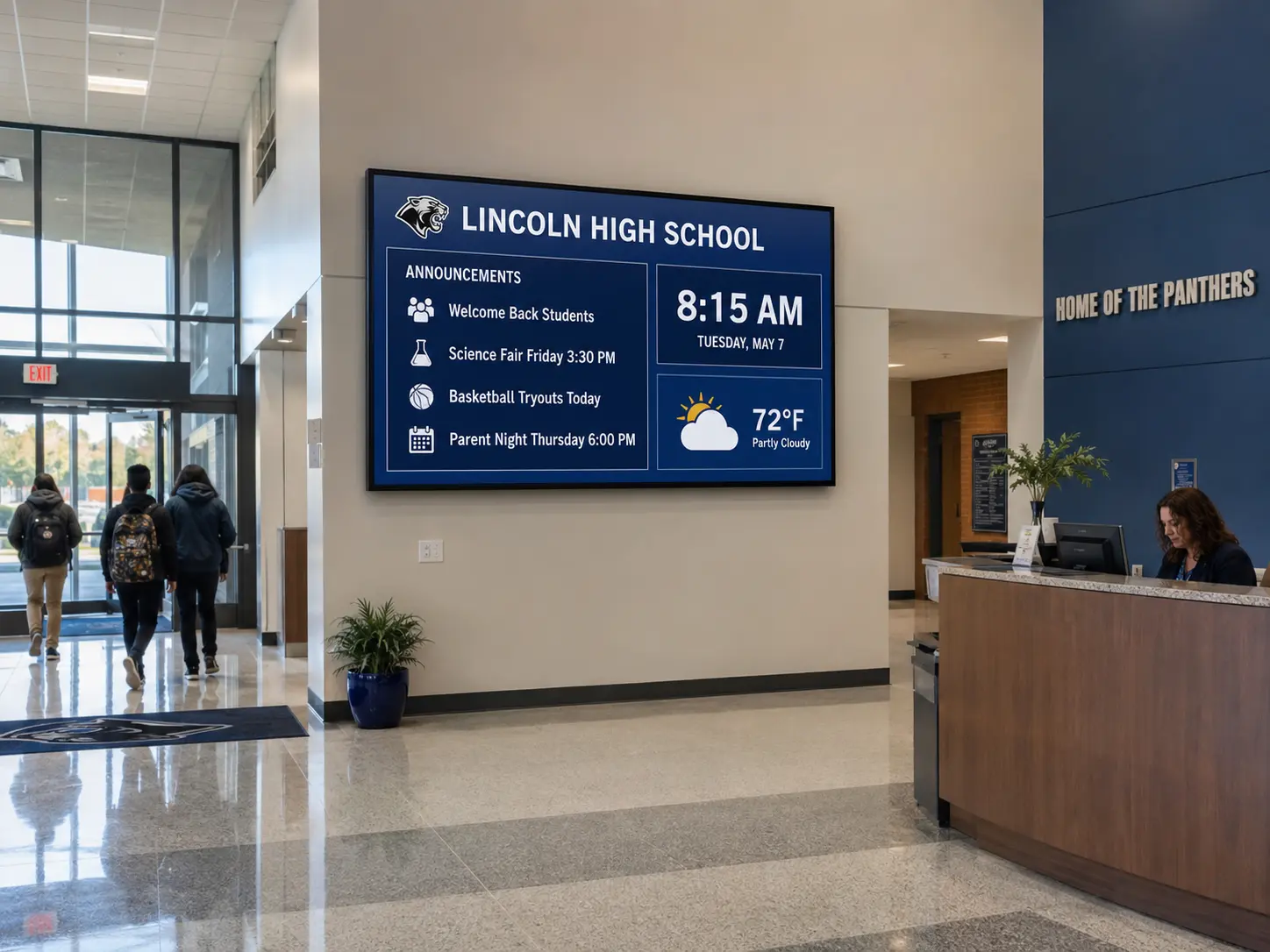
This is the single biggest reason businesses standardize on Apple TV for enterprise digital signage. Many Apple TVs run signage for three or more years without hardware replacement, while consumer sticks in always-on roles tend to need restarts and earlier swaps. For a true 24/7 commercial environment with harsh conditions, a purpose-built player like BrightSign is the next step up, but among these two streaming devices Apple TV is the durable one. Schools standardizing on Apple TV can compare platforms in our best digital signage software for education guide. That durability is one reason campuses standardize on it — our digital signage for education page covers MDM setup and emergency alerts for schools.
Frequently Asked Questions
Is a new Apple TV coming in 2026?
A new Apple TV is widely expected in 2026, but Apple has not released it yet. The Apple TV 4K (3rd generation) remains the current model, so it is still the version you compare against the Fire TV Stick 4K Max today.
Do Apple TV and the Fire TV Stick run the same streaming apps?
Mostly yes. Both run the major services, including Netflix, YouTube, Disney+, Max, Prime Video, Hulu, and Spotify. Apple TV gets them through the App Store, while the Fire TV Stick uses the Amazon Appstore. The main difference is how each interface promotes its own content first.
Does Apple TV or the Fire Stick show more ads?
The Fire TV Stick's home screen leans heavily on sponsored rows and Amazon content, so it shows more ads. Apple TV's interface is cleaner and more content-neutral, which is one reason businesses prefer it for customer-facing screens.
Does the Fire TV Stick support AirPlay?
AirPlay is built into every Apple TV, so you can mirror or stream from an iPhone, iPad, or Mac out of the box. The Fire TV Stick does not natively act as an AirPlay receiver, so it is the weaker choice if you rely on Apple devices.
Can you connect Apple TV and the Fire Stick by Ethernet?
Apple TV 4K's 128 GB model has a built-in Ethernet port, while the 64 GB model is Wi-Fi only. The Fire TV Stick 4K Max is Wi-Fi only and needs a separate Amazon Ethernet adapter for a wired connection, which matters for stable 24/7 playback.
Do you need an Amazon or Apple account to use these devices?
Yes. The Fire TV Stick requires an Amazon account to set up and download apps, and Apple TV uses an Apple Account for the App Store and ecosystem features. For business deployments, Apple TV can instead be managed through Apple Business Manager.
Which remote is better, the Siri Remote or the Alexa Voice Remote?
It comes down to preference. Apple's third-generation Siri Remote is rechargeable over USB-C and uses a clickpad with Siri voice control. The Fire TV Stick's Alexa Voice Remote adds an Alexa button plus power, volume, and channel controls. For signage fleets the remote rarely matters.
Can you control either device with a phone?
Yes. Apple TV can be controlled from the Apple TV Remote built into the iPhone Control Center or the Apple TV app. The Fire TV Stick has the Amazon Fire TV app for iOS and Android, which works as a remote and keyboard.
Conclusion
The Apple TV vs Fire Stick choice splits cleanly by use case. For casual home streaming on a budget, the Fire TV Stick 4K Max delivers 4K HDR and Wi-Fi 6E for under $60, and it is the sensible pick. For digital signage, business displays, and any screen that runs all day, Apple TV 4K is worth the higher price thanks to more RAM, a faster chip, cooler running, and proper fleet management through MDM. Both are good devices in 2026; they are just built for different jobs.
If your screens are for business, Kitcast runs natively on Apple TV, Fire TV, and seven other platforms from one dashboard, starting at $7 per screen per month. See full Kitcast pricing or start a free trial.

Internal Communications Digital Signage: Strategy, Content Ideas & Examples (2026)
6 Best Digital Signage Software for Education in 2026 (Compared)