Every year resets the question: what should you actually build on this year, and what is hype? This is our 2026 read on the digital signage trends that matter, with verified numbers rather than guesses. The short version is that screens are getting bigger, smarter, and more social, while the software running them moves fully to the cloud. Below, each trend is broken down with what it means and how to use it.
The market backdrop is healthy. The global digital signage market was estimated at about $31 billion in 2025 and is projected to reach roughly $58 billion by 2033 at an 8.2% CAGR, according to Grand View Research. That steady growth is what makes the trends below worth acting on rather than watching.
What are the biggest digital signage trends in 2026?
Five digital signage trends define 2026: AI content generation, mega-scale installations, immersive experiences, vertical TikTok-style content, and programmatic DOOH. Retail remains the fastest-moving adopter. Underpinning all of them is cloud-based signage software, now the default for new deployments because it allows remote management, instant updates, and scaling from one screen to thousands without on-premise servers.
What ties these trends together is a shift from screens as static displays to screens as a measurable media channel. A display today is expected to generate content automatically, react to its audience, fit social-first formats, and report on what it does. The rest of this guide takes each trend in turn, starting with the one reshaping day-to-day work the most: AI.
How is AI changing digital signage content in 2026?
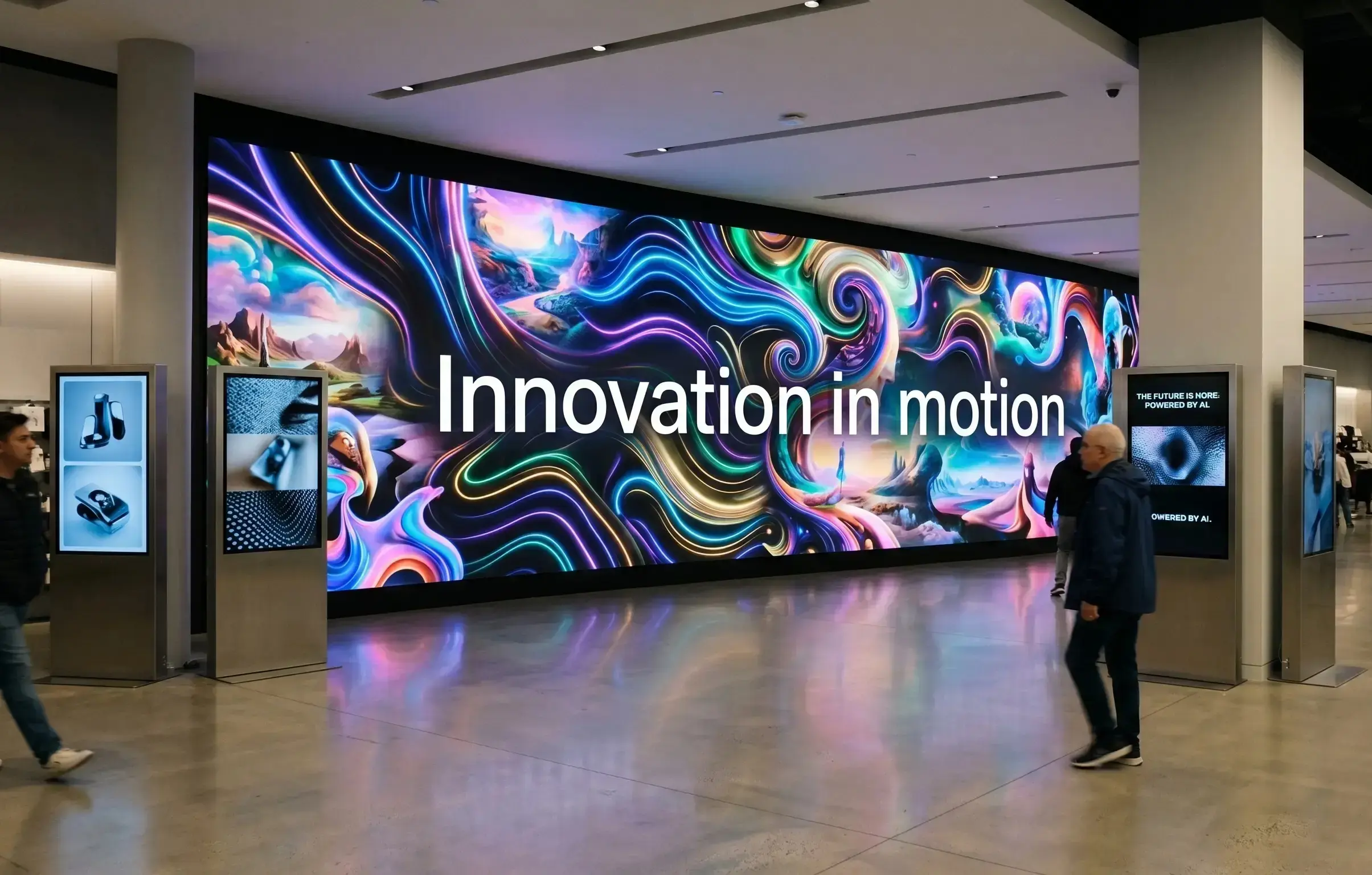
AI is changing digital signage mainly at the content layer: it generates images, video, slide copy, and full templates from plain-language prompts, cutting design time from hours to minutes and letting non-designers produce on-brand slides. This is the most practical trend on the list because it lowers the single biggest ongoing cost of running screens, which is creating fresh content.
In 2024 and 2025, AI moved from novelty to a standard feature inside signage platforms. In 2026 the expectation has flipped: teams assume their digital signage software can draft a layout, resize a video, or write a promo line on request. The benefit is not just speed but consistency, since AI templates keep fonts, colors, and spacing on-brand across every screen.
Beyond content creation, machine learning increasingly drives what plays and when, tailoring content to time of day, location, or audience data. The combination of generative content and data-driven scheduling is what makes AI the defining digital signage trend of 2026, rather than a single feature. To see how this plays out on a real screen network, explore Kitcast's digital signage features.
Why are mega-installations a leading digital signage trend?
Mega-installations are leading because they reset public expectations for what a screen can be, and the appetite for them is clearly still growing. The reference point remains the Las Vegas Sphere, whose Exosphere exterior covers roughly 580,000 square feet of programmable LED, the largest in the world, wrapping a 16K interior display.
The clearest proof that this is a durable trend, not a one-off, is expansion. Sphere Entertainment has announced Sphere Abu Dhabi on Yas Island, its first venue outside the United States, a roughly $1.7 billion project with completion targeted later this decade. Times Square continues to add large-format canvases, and operators worldwide keep commissioning landmark LED facades.
The lesson for most businesses is not to build a sphere. It is that audiences now reward scale, boldness, and spectacle. You can capture the same instinct with a single well-placed video wall and confident, full-bleed content. The trend is about ambition of presentation, not square footage. For shopping-mall executions of that same scale-and-spectacle instinct — American Dream, Dilmunia 8K, Nexus Seawoods anamorphic cuboid — see our best shopping mall advertising campaigns roundup.
What makes immersive and experiential signage matter in 2026?
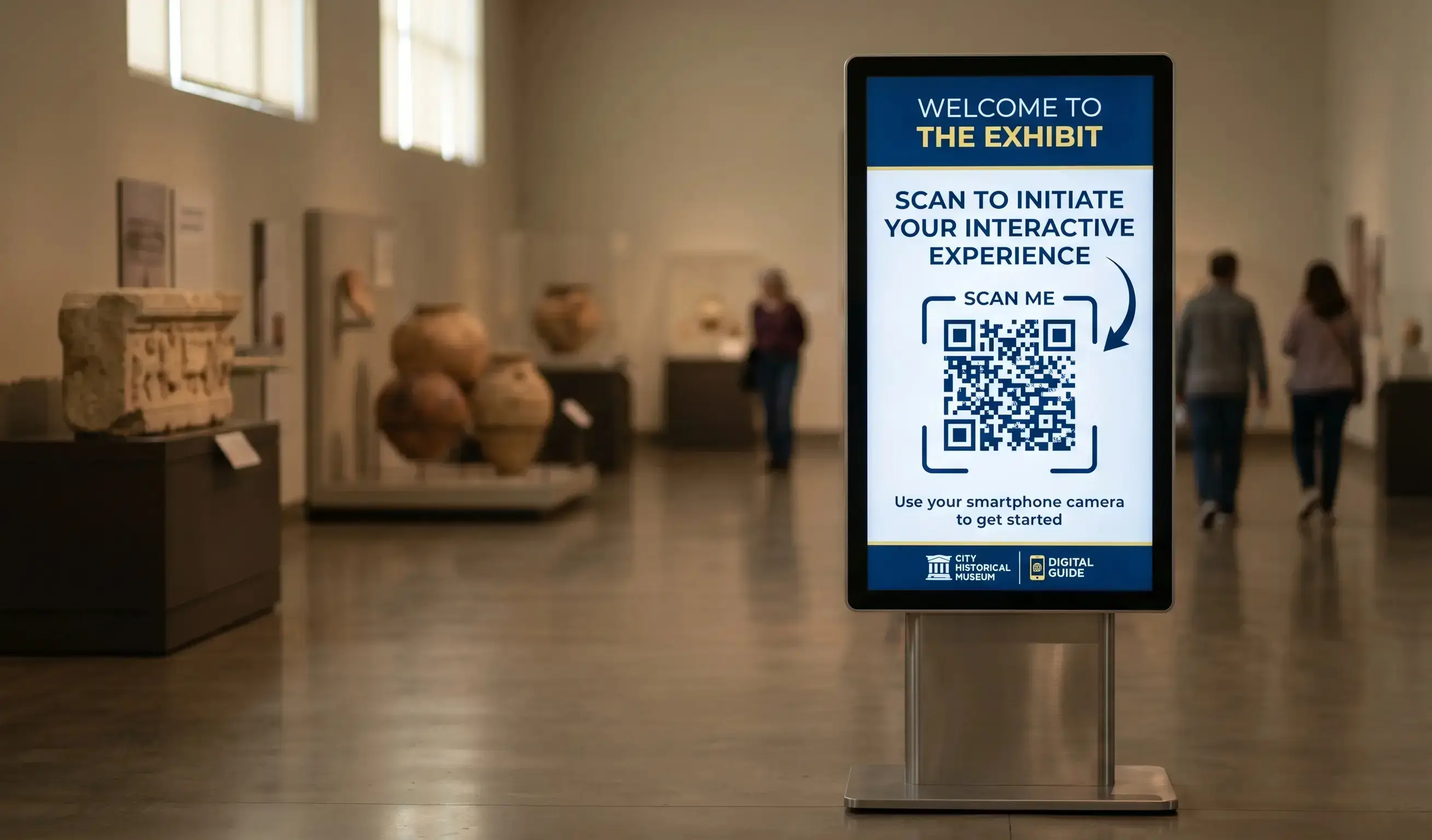
Immersive signage matters because the screen is no longer the destination; the experience around it is. In 2026, displays are expected to do more than show a message, blending AR overlays, sensory elements, 3D and anamorphic illusions, and interactivity to turn a passive viewer into a participant.
This trend grew out of the post-pandemic blurring of online and offline retail and has hardened into an expectation. Customers who can buy anything from their phone visit physical spaces for something the phone cannot give them. Screens bridge that gap: a display that responds to a gesture, reveals an AR layer through a phone, or reacts to who is standing in front of it makes a space worth visiting.
For brands, the practical move is to design for interaction rather than broadcast. Tie a screen to a QR-driven activation, a live data feed, or a touch interaction, and the display becomes part of the experience instead of wallpaper. For the advertising side of immersive screens, see our roundups of AR billboards and 3D ads and hologram marketing examples.
How is vertical, TikTok-style content reshaping screens in 2026?
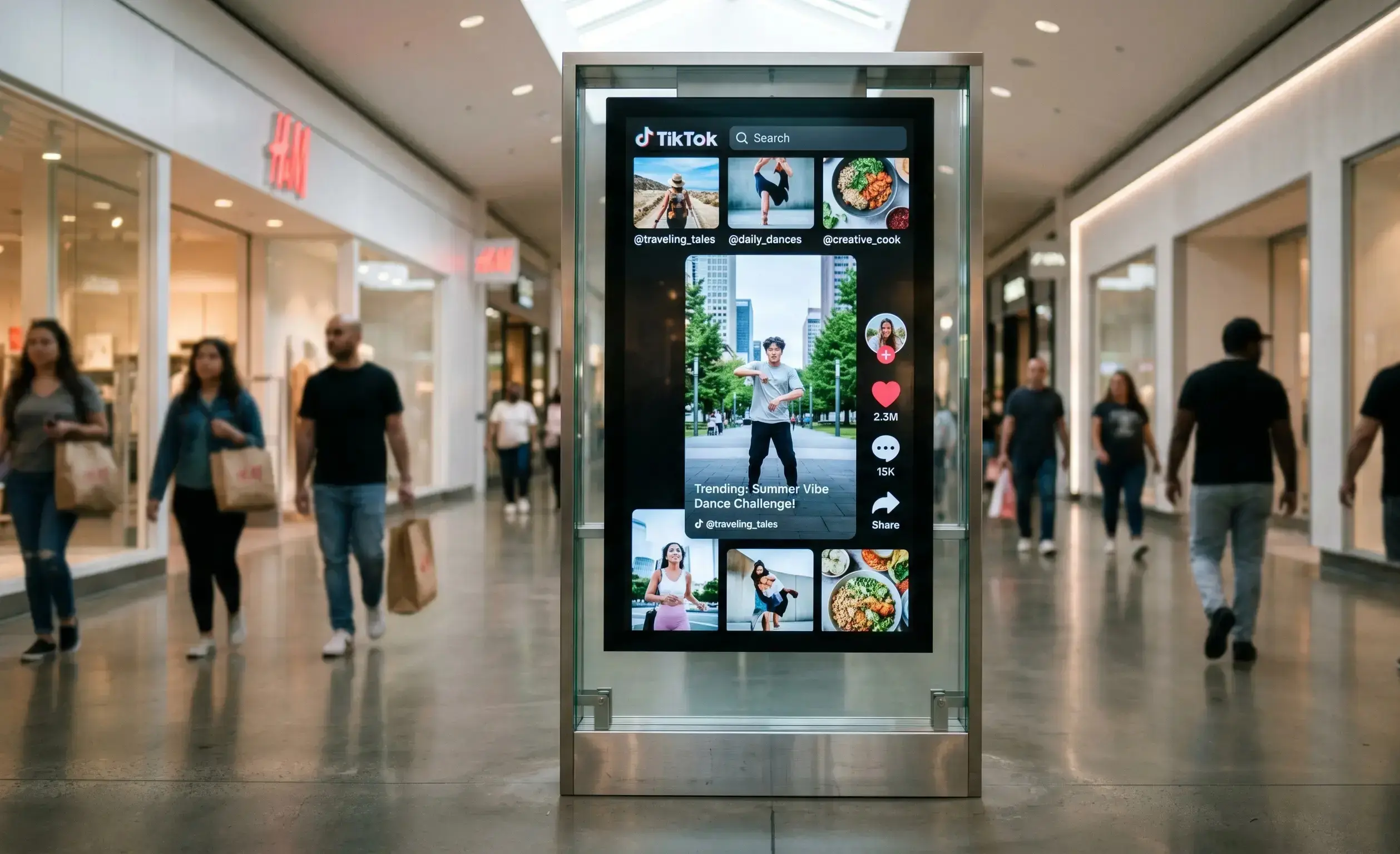
Vertical, TikTok-style content is reshaping signage by importing social-first creative rules onto physical screens: short clips of a few seconds, bold motion, minimal text, and vertical framing where the display allows. The driver is attention. Audiences trained on short-form video give any screen only a moment, so signage content now mirrors what already wins that moment on social platforms.
In practice this means three changes. Content gets shorter and punchier, designed to land in three to five seconds. Vertical and portrait orientations become first-class, matching both phone habits and the growing number of portrait displays in stores and lobbies. And creative borrows the look of social feeds, including live social walls that pull in real hashtagged posts.
This is also where AI and the TikTok format reinforce each other: generative tools make it cheap to produce the constant stream of short, fresh, format-correct clips that social-style signage demands. To run social content on screen, see social media wall displays.
What are the top DOOH trends in 2026?
The top DOOH trends in 2026 are programmatic buying, data-driven contextual creative, and tighter links between outdoor screens and online action. The headline shift is programmatic. Buying outdoor screen time automatically, the way digital ads are bought online, has moved from emerging to mainstream, removing the friction of one-off sales and opening DOOH to advertisers of every size.
The momentum is documented. In its State of the Nation 2026 report, VIOOH found that buyers expect programmatic DOOH to feature in nearly half of all campaigns within 18 months, with investment projected to surge by roughly 44%. The broader channel is healthy too: U.S. out-of-home revenue reached a record $9.46 billion in 2025, with digital out-of-home now about 36% of that total and growing around 10.5% year over year, per the OAAA.
Two other DOOH trends round out 2026. Contextual creative changes the ad based on weather, time, traffic, or audience data, making each play more relevant. And the bridge to online tightens, as QR codes, social handles, and clear calls to action turn a glance at an outdoor screen into a measurable online visit. For a deeper look, read our digital out-of-home advertising trends overview, and for execution ideas see the fast food DOOH campaigns roundup.
What are the key retail digital signage trends in 2026?
The key retail digital signage trends in 2026 are AI-personalized content, smart-store integration, and screens tied to measurable outcomes through retail media networks. Retail is the most active segment for a reason: the retail digital signage market is estimated to grow from about $24 billion in 2025 to roughly $26 billion in 2026 and on toward $35 billion by 2030, per The Business Research Company.
Three retail digital signage trends stand out. First, personalization: AI tailors what a screen shows to time of day, location, and audience, so a display near checkout, in a window, or above a shelf each carries the right message. Second, smart-store integration, with signage linked to point-of-sale, inventory, and loyalty systems so prices, promotions, and stock update automatically. Third, retail media, where retailers sell screen time as advertising inventory and tie exposure to actual sales, turning a cost center into a revenue line.
For most retailers the entry point is simpler: replace static promotions with dynamic, schedulable content, then layer personalization and measurement on top. See how it works on retail digital signage, or for food service, restaurant digital signage and digital menu boards.
How should you act on the digital signage trends of 2026?
Acting on these trends does not require a huge budget; it requires the right software. Cloud-based signage lets you adopt AI content, vertical formats, social walls, and data-driven scheduling on screens you already own, then scale when it works. Start with one strong display and confident content, measure what performs, and expand from there.
The common thread across every 2026 trend is that screens are now a managed, measurable channel rather than decoration. The platforms that win are the ones that make AI content, multi-format scheduling, and remote control easy across one screen or thousands. Ready to put these trends to work? Start a free Kitcast trial and build your first display network in minutes, or compare plans on the pricing page.
FAQ
How big is the digital signage market in 2026?
The global digital signage market was estimated at about $31 billion in 2025 and is projected to reach roughly $58 billion by 2033 at an 8.2% CAGR, according to Grand View Research. Growth is driven by retail adoption, AI and analytics, immersive experiences, and the decline of static printed signage.
What is the difference between digital signage and DOOH?
Digital signage is the broad category: any screen showing managed digital content, indoors or out. DOOH (digital out-of-home) is the advertising-focused subset shown on public and outdoor screens such as billboards, transit displays, and mall screens. All DOOH is digital signage, but not all digital signage is DOOH.
What is programmatic DOOH?
Programmatic DOOH lets advertisers buy outdoor and public screen time automatically through a platform, the way online ads are bought, instead of negotiating one-off placements. It removes friction, opens out-of-home to smaller advertisers, and now drives a fast-growing share of digital out-of-home spend.
What hardware do you need for digital signage in 2026?
A screen, a media player, and signage software. Modern cloud platforms run on affordable, off-the-shelf devices — Kitcast, for example, runs on Apple TV, Android, and Mac mini — so you avoid proprietary players. Any commercial display, or even a consumer TV paired with a media player and a software plan from $7 per screen, can power a professional setup.
Is cloud-based digital signage better than on-premise?
For most businesses, yes. Cloud-based signage offers remote management, automatic updates, and scaling from one screen to thousands without dedicated servers, which is why it is now the standard for new deployments. On-premise still suits a narrow set of high-security or fully offline environments.
Is digital signage worth it for small businesses in 2026?
Yes. Cloud-based software means a small business can run a screen without servers or IT staff, AI cuts content costs, and a single display in a window or at checkout can drive measurable action through QR codes and clear calls to action. Setups scale affordably as the business grows.
What industries use digital signage the most in 2026?
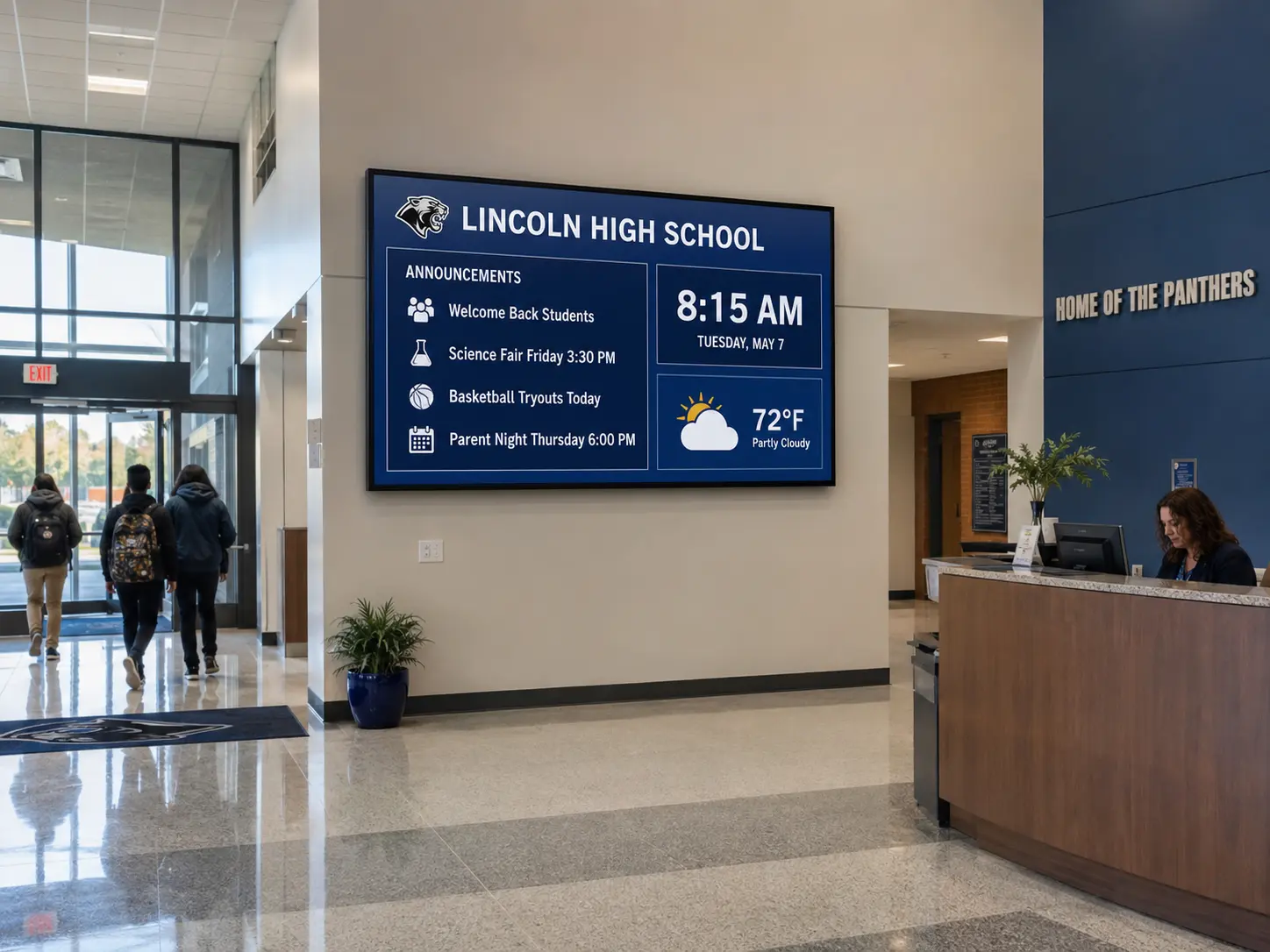
Retail leads, followed by quick-service restaurants, healthcare, corporate communications, education, and fitness. Retail moves fastest because screens tie directly to sales through promotions, personalization, and retail media. Any business with foot traffic or a waiting audience stands to benefit. For campus and classroom deployments specifically, see our digital signage for education page. For gym-floor screens specifically — class schedules, trainer promos, member content — see our gym digital signage page. For what adoption looks like inside clinics and hospitals specifically, see our healthcare digital signage overview.
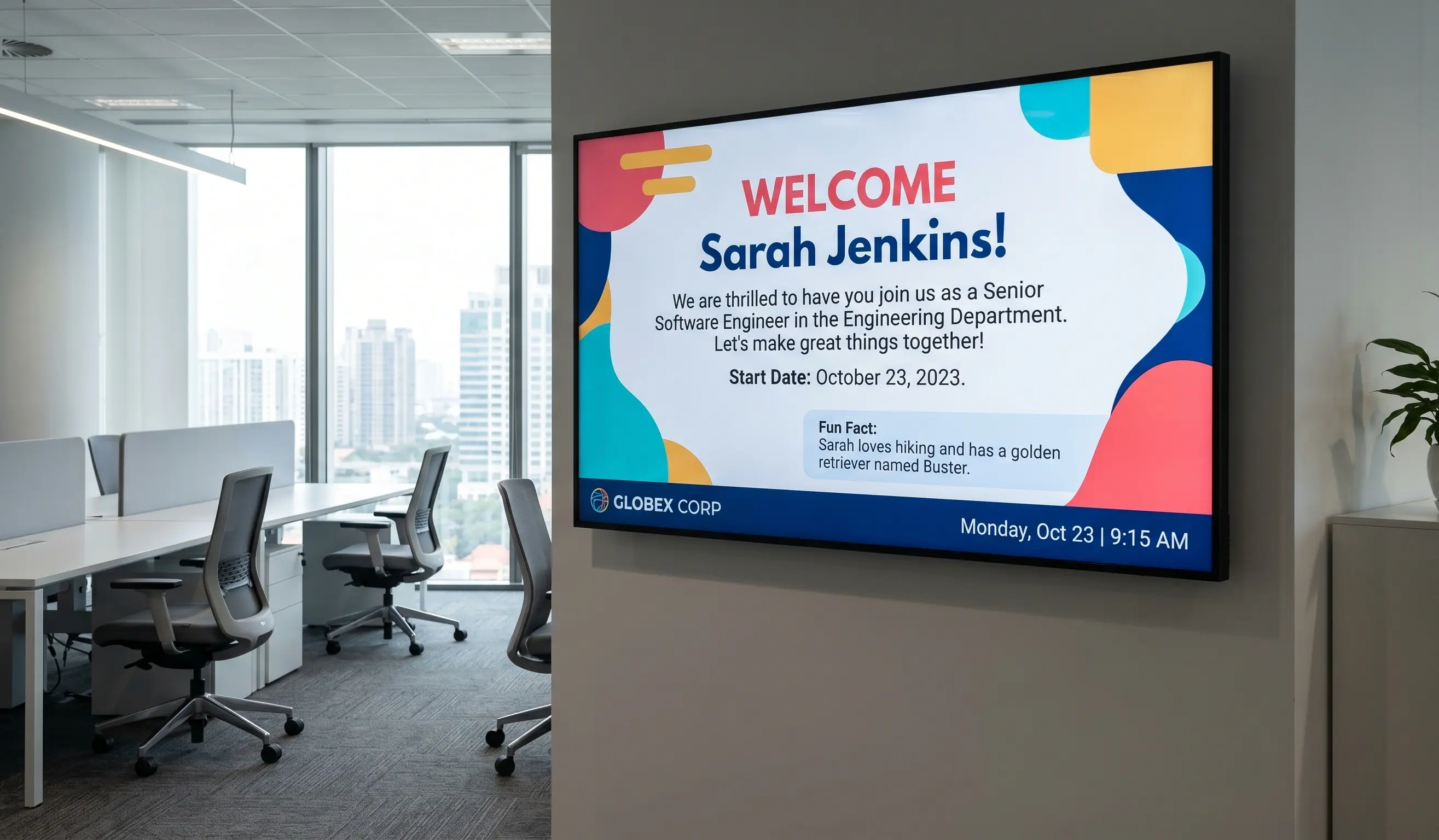
Internal Communications Digital Signage: Strategy, Content Ideas & Examples (2026)
6 Best Digital Signage Software for Education in 2026 (Compared)