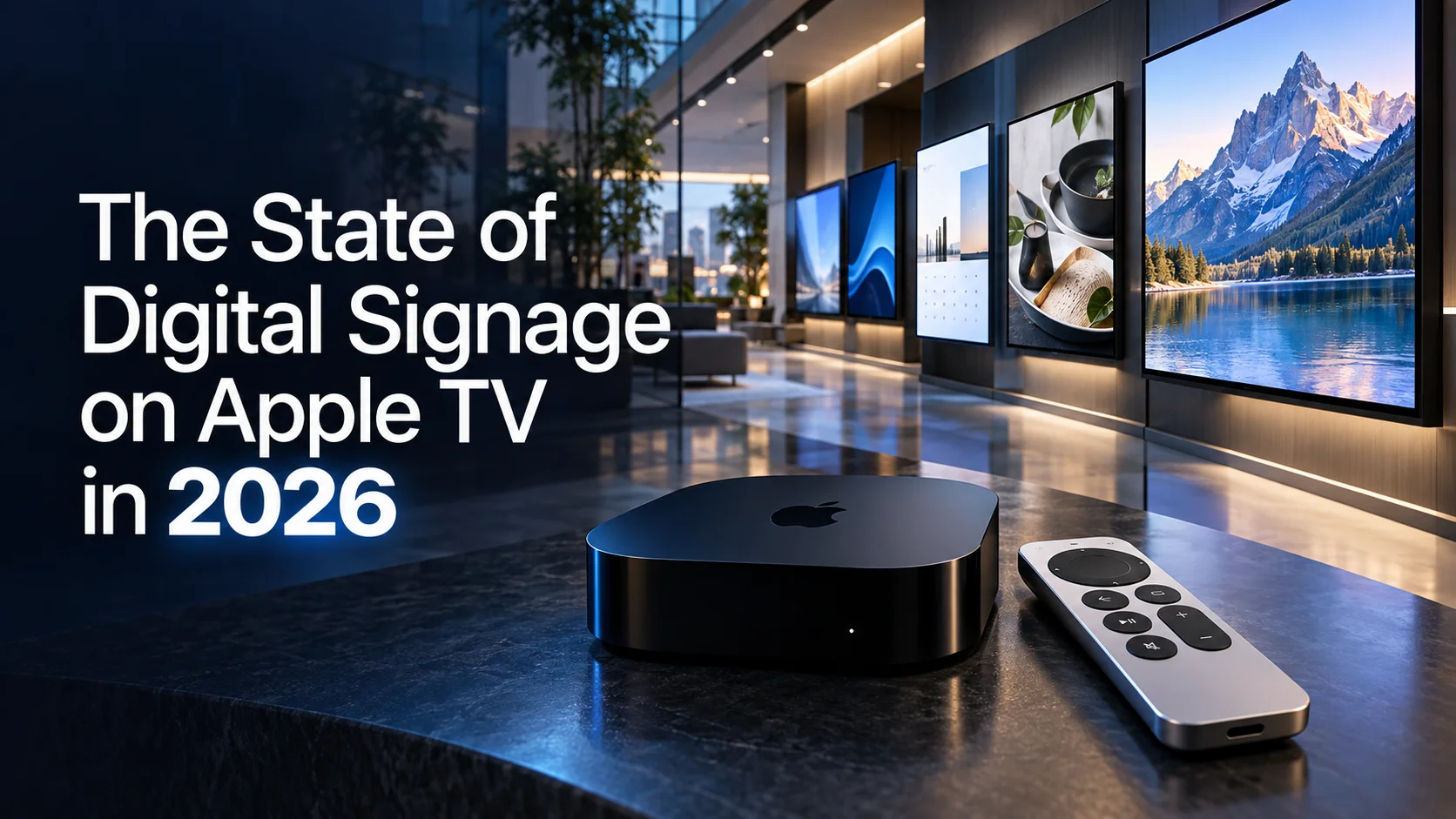
Apple does not sell a digital signage product, yet across Kitcast's fleet the Apple TV behaves like one of the most dependable enterprise appliances you can buy. That is the thread running through this episode of Apple @ Work, where host Bradley Chambers sat down with Kitcast's Egor Belenkov and Pavlo Fedykovych to unpack the numbers behind the report.
We talked about why the device lasts, what zero-touch deployment removes from a rollout, whether the 2026 price increase changes the math, and what a future Apple Intelligence chip could unlock on screen. The full transcript is included below, lightly edited for readability. For the device side of the story, see the digital signage hardware compared breakdown.
Here are the brief points from our talk.
Why is Apple TV so reliable as a digital signage player?
The report's telemetry shows a 99.3% median uptime across Kitcast's Apple TV fleet and a replacement rate of about 2%, against roughly 18% for cheap Android sticks. That is close to a 9x difference in reliability, and it comes down to three things.
The first is tvOS, a single-purpose operating system with aggressive memory management. There are no leaks that force a device to reboot and no background junk piling up that needs someone to walk over and pull the plug.
The second is Apple Silicon. Apple TV runs the same class of chip as an iPhone, engineered to survive 4K video and gaming inside a sealed, fanless case, so it is massively over-engineered for what a screen actually asks of it.
The third is thermal design. A cheap chipset in a plastic stick hanging behind a hot TV lives at its thermal limit from day one, and heat is what kills electronics. Put together, the result is a device that just runs, which is exactly what an IT team managing screens across many locations needs. See enterprise digital signage for how that plays out at scale.
How much does zero-touch deployment save on large rollouts?
Provisioning Android players across hundreds of locations is a staging operation. Each device ships to a warehouse, someone unboxes it, taps through setup, installs the app, configures a portal, repacks it, and reships it to the site. Even at 15 minutes per device, 500 devices is over 100 man-hours, plus double shipping and a chance for human error at every step.
With Apple, that phase does not exist. Through Apple Business Manager, devices ship from Apple straight to the site already assigned to the organization and enrolled in mobile device management. The same zero-touch workflows Apple built for the Mac and iPad apply to the Apple TV, and tvOS updates can be managed and enforced from the same console. For stationary screens, the Apple TV also keeps a wired Ethernet option, which takes the load off Wi-Fi on new builds where you can run a cable to every display.
Is the Apple TV worth it after the 2026 price increase?
Apple TV now starts at $199, and it is the most expensive of the consumer-grade options. But the price pressure is not unique to Apple. BrightSign, the largest dedicated signage player, moved to a quarterly pricing model and dropped price protection, warning that replenishment prices can reflect the market on the day of fulfillment. Any vendor that buys RAM and flash is affected, so budget sticks are climbing too.
Over a five year lifespan, a reliable box that rarely needs a service visit tends to cost less in total than a $49 device that has to be rebooted twice a week and eventually needs a truck roll. There is also a budget angle for some sectors: schools and universities often already own Apple TVs and can repurpose them for signage rather than buying new hardware. Framed correctly, digital signage works as a revenue tool rather than a cost center, since screens sell products, upsell menus, and cut printing costs. Compare live tiers on the Kitcast pricing page.
What could on-device AI mean for Apple TV signage?
The part Egor is most excited about is what happens when a future Apple TV ships with an Apple Intelligence class chip. At that point, every screen stops simply being a player and becomes an edge AI node, with the intelligence included in a roughly $200 box rather than a server or GPU.
Full episode transcript
Apple @ Work, "The state of digital signage on Apple TV in 2026." Host: Bradley Chambers (9to5Mac). Guests: Egor Belenkov (Kitcast CEO) and Pavlo Fedykovych (Kitcast Head of Communications). The episode opened with a sponsor message from Mosyle.
Bradley Chambers: Welcome to Apple @ Work, the podcast all about Apple and the enterprise. My name is Bradley Chambers, your host as always. This week on the show, we have Egor and Pavlo from Kitcast here to talk about their recent report, State of Digital Signage 2026. Guys, welcome to Apple @ Work.
Egor Belenkov: Hi.
Pavlo Fedykovych: Hello, thank you for having us.
Bradley Chambers: Kitcast is a longtime friend of mine. It's who you all work for, and it's a great, great report. Kitcast, again, I'm talking out loud here, was one of the very first companies to really pioneer using digital signage on Apple TV. I've used you guys a long, long time. Great product. And I think we're here to talk as much about the hardware as anything. So before we get started, Egor, I'll let you start. Give us the high level. Where did the idea for Kitcast come from when the company was just starting?
Egor Belenkov: Yeah, thank you very much. Really great question. When we started with Kitcast, it was almost 10 years ago, and back then the whole digital signage landscape looked absolutely different. There were no smart TVs and not a lot of media players. We experimented with different kinds of devices and tried to launch on Apple TV. Back then, the Apple TV had no app store at all, so we jailbroke it, launched Kitcast, and it was flying. So we bet everything we had on Apple TV and started to develop the app there. That's how it started.
Bradley Chambers: I've been interested in Apple TV as a digital signage tool even before this version of the Apple TV. If you remember the one prior to that, the really thin one, that would never scale, but I actually experimented with setting the screensaver to a Flickr album. The Flickr album had slides uploaded to it. So you make the slides, export them as images, upload them to a Flickr album as a picture hosting service, then owned by Yahoo, and it worked great.
And for anyone listening who is not familiar with digital signage at all, before this current era of good, low-cost boxes, this was a very complicated and very expensive industry. It was one of those where you had to hire an integrator to get it done. Now it's as simple as buying some devices and getting a service connected to them, and you're up and running. There are some amazing things you can do. You all were the pioneers here. Apple's own attitude toward the Apple TV as an enterprise appliance has evolved too. Price-wise, Apple TV is still more expensive than lower-cost Fire Sticks and Android boxes. But what I'm seeing is that it's incredibly easy to manage and scale the Apple TV from the device side. Apple doesn't sell digital signage, but they do ship first-class enterprise management. Do you think that's one of the things the IT side has really appreciated? Like, we like the Kitcast service, but we also like the management Apple gives us of the boxes alongside our existing ecosystem of Macs and iPads and iPhones?
Egor Belenkov: Yeah. There are three different topics here: pricing, management, and Apple as an enterprise device. But it's the whole combination that matters, especially pricing combined with an MDM service. Take zero-touch deployment, for example, because provisioning Android players for hundreds of locations is a staging operation. The device is shipped to a warehouse first, someone unboxes each one, taps through setup, installs the app, configures a portal, repacks it, and reships it to the site. Even at 15 minutes per device, 500 devices is over a hundred man-hours, plus double shipping and human error at every single step. With Apple, that phase simply doesn't exist, because the device ships from Apple straight to the store for mass deployment, already assigned to the company. So it's a huge benefit for the admins and for IT departments.
Bradley Chambers: Yeah, I agree, and I was going to add that. When it comes to scalability, cheaper Android boxes and cheap Fire Sticks are obviously, dollar to dollar, cheaper than the Apple TV. And I will say the Apple TV's recent price increase hurt. It was already more expensive. But I come at it from the mindset, and we'll get into some of this telemetry data shortly; I want to ask Pavlo about that. I would rather pay more, because these boxes are going to last. Apple TVs will last a minimum of five years, and honestly, some could last until Apple stops supporting them with versions of tvOS, and Apple is not releasing new versions all the time. Compare a $229 device to a $50 Android device. On paper, it's more expensive. But you mentioned the setup, and then there's the troubleshooting on the back end. Does it have to be rebooted? There are a lot of things like that.
So if you're looking at even one large campus with 100 devices, or 100 locations with one TV each, I want scalability and manageability. I'm not saying cost isn't important. But the first time you have to roll a truck to go deal with a cheap Android box, you've eaten up the cost. I would rather have something I can manage in an enterprise way, not just get a $50 device and then hope that when the power goes out it comes back to the right screen. And I think that moves into something interesting. The report is really interesting; there's lots of good data, and I'll have a link in the show notes. Even if you're not a Kitcast customer, I found it very interesting. Your data shows that the cheap Android sticks have a higher replacement rate of about 18%, compared to the Apple TV at about 2%. That's a 9x difference. Obviously, I think Apple does a good job here, but the chips in the Android devices are also fine. Do you think this is something on the software side? Do you think it's thermal design? What do you think led to the Apple TV being so much more resilient in the enterprise?
Pavlo Fedykovych: Yeah. I just wanted to say that Apple TV, they don't market themselves as an enterprise device, but they absolutely are one from our experience, from this telemetry, from all these stats. It's a combination of things. First of all, it's tvOS, which is stable and has great memory management. If you compare that to Android devices, the software there sometimes lacks the things tvOS has. There are memory leaks, apps can get killed, devices reboot, all these kinds of problems. And then you go to the hardware. The silicon is better, the thermal design is better, and the Apple TV is built to last. As the data shows, it's a really durable device that you don't have to change. It just runs, on many screens. Zero-touch deployment, MDM, it works, and Kitcast works with that. So that's what the data shows.
Egor Belenkov: Yeah, I want to dive a little bit deeper, because comparing Apple TV with any media player that costs less than 50 bucks, Apple massively over-engineers this device for what we ask it to do. The Apple TV runs the same Apple Silicon as an iPhone, which is designed to survive gaming and 4K video inside a sealed phone with no fan. Maybe you remember that time 5 or 10 years ago when your MacBook was heating like crazy and you could hear all the fans. The Apple TV nowadays never cooks itself. A cheap chipset in a plastic stick hanging behind a hot TV lives at its thermal limit from day one, and heat is what kills all electronics. Same with power delivery and quality storage: cheap sticks usually die exactly there. And tvOS is a single-purpose OS with aggressive memory management, as Pavlo mentioned. No background junk piling up, no leaks that need someone to walk over and pull the plug. Amazon now sells a dedicated signage stick, a Fire Stick in a business suit. That's what Apple never does. Apple never tried to repackage the consumer device in a business suit. We don't have a specific MacBook Pro for business, it's just a regular consumer device. And the number tells the story in our State of Digital Signage report: Apple TV shows a 99.3% median uptime across our fleet. I still can't believe that number.
Bradley Chambers: When I think about how Apple recently overhauled Apple Business Manager, the same zero-touch workflows they've built for the Mac and the iPad are there for the Apple TV, so it makes distribution incredible. One of the things I think is underrated is keeping the software up to date. If you buy a $50 Android stick from a big box retailer, and you buy 50 of them, are they going to be updated? How are they getting updated? Another underrated thing about the Apple TV is that there's still an Ethernet option. If it's stationary, I love to hardwire things. If you're doing a new build, you can wire Ethernet to all your digital signage, take the load off the Wi-Fi, and eliminate a variable. It's very flexible. And you can keep it up to date, managing tvOS updates through your device management system and enforcing certain things. That's going to be more challenging on a budget Android device. It may not even support over-the-air updates; it may never get them, and you don't even know what version of Android it's on. I'm not saying Android is bad. There are digital signage solutions built on top of Android, but generally those are more integrated boxes. A lot of these cheap options are just installing an app on a Fire Stick, and it's a challenge to keep it up to date.
Apple has over-engineered the chip. It's way more powerful than it ever needed to be for the content on it. So I'm wondering, do you think there's going to be some on-device AI? Could we start seeing localized AI content generation? I'm talking out loud here. There are a lot of cool things happening with Apple and on-device AI. I wonder if there are opportunities with an app, say we get a new Apple TV that's even more powerful. What's the vision? What's the pie in the sky? Are there cool things out there we're not thinking about?
Egor Belenkov: That is probably the part I'm most excited about for the future of Apple TV. Thanks to all the streaming services, we've seen Apple's vision for Apple TV as one of the core platforms for their streaming. The rumors say the next Apple TV gets an A17 Pro, the same class of chip that runs Apple Intelligence on the iPhone. Once that lands, every screen out there stops being just a dumb player and becomes an edge AI node. You don't buy a server, you don't run GPUs, the intelligence is included in a $200 box.
So what does that unlock in signage? Maybe three things, in order of realism. First, context-aware content: the box reacting locally to time of day, weather, store inventory, and foot traffic, assembling and rendering the right message on the spot instead of playing a pre-baked video. That's near term. Second, and this is probably the big one, privacy-safe analytics. Today audience measurement means streaming camera feeds to somebody's cloud, which is a compliance nightmare. We don't have many customers with that kind of integration, cameras connected to the Apple TV processing all the data in the cloud. With on-device AI, the video never leaves the box, it can process everything internally. And the last part, full generative content on the box, honestly stays hybrid for a while: heavy generation in the cloud, real-time adaptation and rendering at the edge. So the evolution is simple. Apple keeps shipping phone-class silicon into this little box, and our job with Kitcast is to turn every one of those boxes into the smartest screen in the building.
Pavlo Fedykovych: Yeah, I just wanted to say it's very interesting what Apple will do with Apple TV on this update. Kitcast has run on Apple TV for so many years, and Apple TV was first marketed as a consumer device, but it's actually much more than that. I'm excited about what they will put inside for this AI update. I also think an interesting angle is what they do with smart home, and how it will manifest itself with a smart home kind of connection to other devices in the Apple network.
Bradley Chambers: Wrapping up, and I mentioned it, Apple across the board raised prices pretty significantly across all of its products. That's not unique to Apple; it's across the entire industry, but the Apple TV did see a pretty significant price increase, so it does start at $199. It's the most expensive of your consumer-grade options. I don't really want to ask whether the Apple TV is worth it in the home, but do you think this price increase makes it tougher for IT teams to justify Apple? Or is the value still there in terms of manageability and scalability? Obviously, if it were $500, that's one thing, but even at $199, I'd rather put in a $199 device that works and is reliable for five plus years than a $49 cheap stick I have to reboot twice a week. What are your thoughts on this price increase?
Egor Belenkov: Yeah, you mentioned it right; it's not only about Apple products. Everybody is raising prices, and that's probably the key point. Look at BrightSign, the biggest dedicated signage player out there. They didn't just raise prices once. I got their email a couple of weeks ago: they moved to a quarterly pricing model because of the memory market and dropped price protection entirely. They even warn that if stock runs out, the replenishment price reflects whatever the market is on the day of fulfillment. Think about that as an IT buyer: you can't even lock a price for a big rollout anymore. So this is not just an Apple or Apple TV problem. It's macroeconomics hitting every vendor that buys RAM and flash, which is all of them. I do believe the value is still there, and even compared to other vendors, you get more value than what's on the market today. Pricing across all vendors is going to increase for the next couple of years.
Bradley Chambers: That's great feedback. The truth is this is not unique to Apple, everybody is going to see a price increase. So your cheap Apple TV or cheap Android stick that used to be 50 bucks may be $69.99 shortly as well.
Egor Belenkov: And Apple at least gives you one fixed number. In a $50 stick, memory is a bigger slice of the cost, so proportionally the cheap ones get hit hardest.
Pavlo Fedykovych: I wanted to add that there's also a business dimension to this. There are two ways to look at the price increase and how it affects organizations. For some, education, for example, many already have Apple TVs and use them actively, not for digital signage. So for them it's much more budget-friendly to just repurpose that device, and it's our job to show them the possibilities. They happily do it. The other dimension is reliability. As the data showed, it's only a 2% replacement rate versus 18% for Android sticks. It's a very durable device, and in the long run it saves you money.
Egor Belenkov: Yeah, and digital signage works as a revenue tool, not a cost center. Screens sell the product, upsell menus, and cut printing costs. If a $200 box helps your business make $300, it makes sense.
Bradley Chambers: Absolutely. Egor, Pavlo, this has been a great discussion. Thanks for taking the time. I'm a big fan, even if you're not using Kitcast, of Apple TV as a digital signage tool for the reasons we mentioned: it's scalable, it's manageable, and it's reliable. You'll see some of these last seven or eight years, as long as Apple is updating it and it's in a well-ventilated area. You can see the breakage rate in the link in the show notes, really small breakage rates compared to other devices. So guys, thanks for taking the time to chat. We'll have a link in the show notes where you can read the full report, the Kitcast State of Digital Signage 2026 report. And we'll talk to everybody next week.
Frequently Asked Questions About Apple TV
How reliable is Apple TV for digital signage?
In Kitcast's State of Digital Signage 2026 telemetry, Apple TV showed a 99.3% median uptime across the fleet and a replacement rate of about 2%, compared with roughly 18% for cheap Android sticks. That is close to a 9x difference in reliability.
Why does Apple TV last longer than a cheap Android media stick?
Three reasons come up in the episode: tvOS memory management that avoids leaks and forced reboots, Apple Silicon that is over-engineered for signage workloads, and thermal design. A fanless chip built for a sealed iPhone runs cool, while a cheap stick behind a hot TV sits at its thermal limit, and heat is what kills electronics.
What is the Apple TV replacement rate compared to Android sticks?
Kitcast's telemetry shows an Apple TV replacement rate of about 2%, versus roughly 18% for cheap Android sticks. Over a five year lifespan, that reliability gap means far fewer failures, service visits, and truck rolls.
Is Apple TV worth it after the 2026 price increase?
Apple TV now starts at $199. Prices are rising across the whole industry because of the memory market, so budget sticks are climbing too. Over a five year lifespan, a reliable box that rarely needs a service visit tends to cost less in total than a $49 device that fails often and requires truck rolls.
What is zero-touch deployment for Apple TV?
With Apple Business Manager, devices ship from Apple straight to the site already assigned to the organization and enrolled in MDM. That removes the manual staging phase that Android rollouts require, where each device is unboxed, configured, repacked, and reshipped. At 15 minutes per device, 500 devices can mean more than 100 man-hours saved.
Does Apple TV support wired Ethernet for digital signage?
Yes. The higher-end Apple TV includes a wired Ethernet option. For stationary screens, hardwiring the signage takes the load off Wi-Fi and removes a variable that can cause playback issues, which is especially useful on new builds where you can run Ethernet to every display.
How are tvOS software updates handled compared to Android?
On Apple TV, you can manage and enforce tvOS updates through your device management system, so the whole fleet stays current. A budget Android stick may not support over-the-air updates, may never receive them, and often leaves you unsure which version of Android it is running.
Can schools and universities repurpose existing Apple TVs as signage?
In many cases, yes. Schools and universities often already own Apple TVs and use them actively, so repurposing those devices for signage is more budget friendly than buying new hardware. Kitcast's role is to show them what the device they already have can do.
Why are digital signage hardware prices rising in 2026?
Prices are climbing across the whole industry because of the memory market, not only at Apple. BrightSign, the largest dedicated signage player, moved to a quarterly pricing model and dropped price protection, warning that replenishment prices can reflect the market on the day of fulfillment. Any vendor that buys RAM and flash is affected.
Will the next Apple TV enable on-device AI for signage?
If a future Apple TV ships with an Apple Intelligence class chip, each screen could become an edge AI node. The near-term use is context-aware content that reacts locally to time, weather, and foot traffic. The bigger opportunity is privacy-safe audience analytics where the video never leaves the box, with full generative content staying hybrid for now.
Is digital signage a cost or a revenue tool?
Digital signage works as a revenue tool rather than a cost center. Screens sell products, upsell menus, and cut printing costs. If a $200 box helps a business earn more than it costs, the investment pays for itself.
Conclusion
The takeaway from the episode is consistent with the data: at scale, the sticker price of a signage player matters less than how long it lasts, how little it needs to be touched after install, and how easily IT can manage it alongside the rest of the Apple fleet. On uptime, replacement rate, zero-touch deployment, and enforced updates, the Apple TV lands on the right side of all four, and an Apple Intelligence chip would push the story further toward the edge.
Kitcast has run digital signage for over 10,000 teams since launching the first native Apple TV signage app in October 2015. Starter pricing is $7 per screen per month with no per-feature gating on the essentials. Read the State of Digital Signage 2026 report, see Kitcast pricing.
Internal Communications Digital Signage: Strategy, Content Ideas & Examples (2026)
6 Best Digital Signage Software for Education in 2026 (Compared)