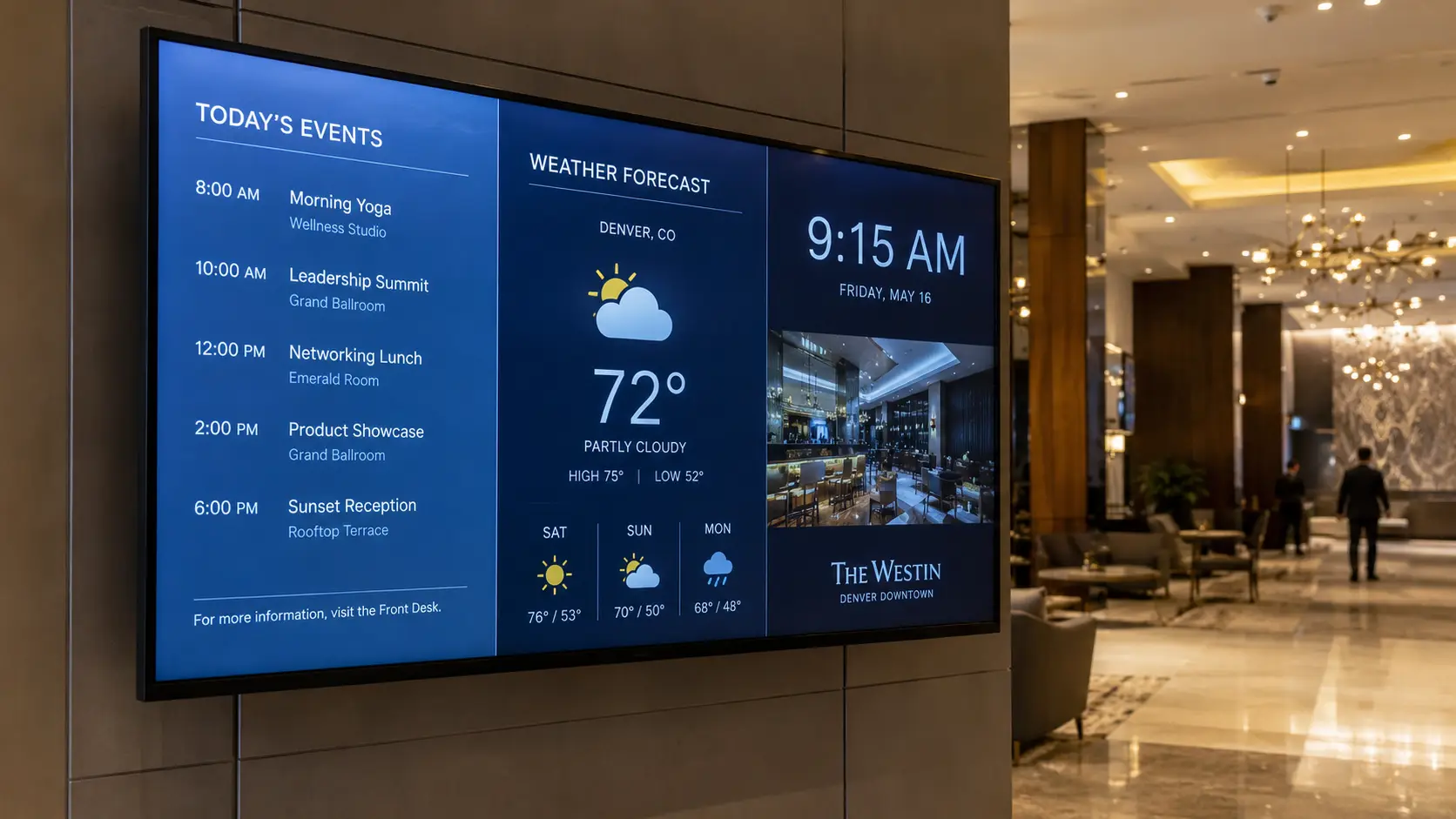
Hotel screens are held to a higher standard than almost any other signage. According to the State of Digital Signage 2026 report, hospitality runs the freshest signage of any measured industry – content is updated at a median of every 3.9 days, more than four times faster than the all-industry median of 16.8 days. Guests glance at a lobby screen expecting today's events, current weather, and accurate times – and hotel teams actually deliver. That pace is exactly what your software has to keep up with. We compared the market on the criteria that matter for hospitality: ease of daily updates, lobby-grade reliability, multi-property control, and honest pricing.
Disclosure: Kitcast makes digital signage software. This comparison uses published pricing and features verified in July 2026 – including where competitors beat us.
Comparison Table: Hotel Digital Signage Software at a Glance
| Software | Best for | Multi-property | Offline playback | Starting price (annual) |
|---|---|---|---|---|
| Kitcast | Lobby screens, Apple TV fleets, multi-property groups | Yes, all plans | Yes, all plans | $7/screen/mo |
| NoviSign | Hospitality templates & interactive boards | Yes | Yes | $18/screen/mo |
| ScreenCloud | Large hotel groups with corporate comms | Yes (Pro+) | Varies | $20/screen/mo + VAT |
| Yodeck | Single property on a budget | Enterprise tier ($16) | Yes | $8/screen/mo (free 1st screen) |
| OptiSigns | Mixed hardware, POS-fed restaurant menus | Pro Plus tier | Varies | $9/screen/mo |
| Rise Vision | Event calendars & schedule boards | Enterprise tier | Yes | ~$10-11/screen/mo |
| PosterBooking | Free tier for a couple of screens | Limited | Varies | Free up to 10 screens (with caveats) |
Pricing verified July 2026; plans change – confirm current rates with each vendor.
What should hotel digital signage software do?
A hotel's screens are a concierge that never clocks out. The data shows what guests actually see on hospitality screens: weather runs on 87% of them, media and imagery on 82%, date and time on 75%, event calendars and schedules on 42%, and news on 34% (State of Digital Signage 2026, content scan of 10,000+ screens). The software's job is to keep that mix effortless: automatic feeds for weather and time, scheduled event boards that expire on their own, brand-consistent templates the front-desk team can edit without a designer, and offline playback so a Wi-Fi hiccup never turns the lobby screen black. For groups, one dashboard has to cover every property with local editing rights per hotel.
1. Kitcast
Best for: Lobby and guest-facing screens, Apple TV deployments, and multi-property hotel groups.
Kitcast runs natively on nine platforms – Apple TV, Android TV, Fire TV, BrightSign, Samsung Tizen, LG webOS, macOS, iOS, and any web browser – so hotels deploy on hardware they already own. It shipped the first digital signage app on the Apple TV App Store in October 2015, and the Apple TV route is popular in hospitality for a reason: a small, silent player behind a lobby TV, managed remotely via Jamf, Mosyle, or Kandji.
Content is cached locally on every plan, so screens keep playing through network outages. Multi-location screen groups, role-based access (front desk edits their property; group marketing controls the brand), 500+ templates including weather, clocks, and event boards, and a REST API for PMS or event-system data. Trusted by 10,000+ teams including Marriott.
Honest weakness: no free tier – pricing starts at $7/screen/month (Pro at $10 adds SSO, SCIM, API, and audit logs).
2. NoviSign
Best for: Hospitality-specific templates and interactive lobby boards.
NoviSign leans into hospitality with dedicated hotel, QSR, and café template sets – 500+ templates and 50+ widgets, with drag-and-drop free-form layouts that suit event boards and interactive directories. Offline playback is included on the Business plan, and platform support spans Android, Samsung Tizen, LG webOS, Windows, ChromeOS, BrightSign, and Amazon devices.
Honest weakness: the most expensive entry point of the SMB group at $18/screen/month (Business Plus at $26), and no Apple TV app.
3. ScreenCloud
Best for: Large hotel groups running corporate communications alongside guest screens.
ScreenCloud positions for enterprise deployments – back-of-house employee communications, dashboards, and multi-department permissions – with a large app library (80+ integrations) and support for Fire TV, Samsung Tizen, LG webOS, and Android. If your hotel group treats signage as an internal comms platform for staff as much as a guest amenity, it's a serious option. If ScreenCloud is on your hotel shortlist, our ScreenCloud alternative comparison shows how the two stack up on price and features.
Honest weakness: at $20/screen/month plus VAT it costs two to three times more than most competitors here, with no free tier and no Apple TV or Raspberry Pi support listed.
4. Yodeck
Best for: A single property on a tight budget.
Yodeck's free-forever single-screen plan is the cheapest way to put one lobby screen to work, and paid plans start at $8/screen/month with a free Raspberry Pi player on annual billing. Templates number 800+, and platform support covers Raspberry Pi, Android, Windows, Samsung Tizen, LG webOS, and Fire TV.
Honest weakness: advanced scheduling sits on the $12 Premium tier and multi-property workspaces on the $16 Enterprise tier – and there's no Apple TV support at all.
5. OptiSigns
Best for: Mixed hardware fleets and hotels with POS-fed restaurant menus.
OptiSigns starts at $9/screen/month with a broad template library, and its OptiSync data feature (Pro Plus, $13.50/screen) syncs menu content from Toast or Square – relevant if your property runs a restaurant or café with changing menus. Hardware support is broad across consumer devices.
Honest weakness: the POS-driven features that make it interesting for hotel F&B require the Pro Plus tier – 50% above its entry price – and enterprise plans carry a 25-screen minimum at $45/screen.
6. Rise Vision
Best for: Event calendars and schedule boards.
Rise Vision's calendar-first templates (750+) suit conference-room schedule boards and event displays, with offline playback included on the Basic plan (~$10-11/screen/month, quote-based pricing).
Honest weakness: the product and pricing are built around K-12 schools first – hospitality is not its focus, and Apple TV support is limited (no screen-sharing).
7. PosterBooking
Best for: Trying digital signage for free.
PosterBooking offers a free tier for up to 10 screens – the lowest barrier to entry on this list for a small property that wants to experiment before committing.
Honest weakness: third-party reviews report watermarks on free screens, paid pricing is bundled rather than per-screen, and during our July 2026 verification the vendor's own pricing page was returning errors – factor reliability into your evaluation.
How do hotels actually use their screens?
Two patterns stand out in the fleet data. First, freshness is the differentiator: hospitality's 3.9-day median content age is the fastest of any vertical – twelve times faster than education – because events, rates, and promotions change daily. Choose software your least technical front-desk shift can update in minutes, or the screens will fall behind the property. Second, the content mix is concierge-like: weather (87%), ambient media (82%), time (75%), event calendars (42%). Most of that should run on automatic feeds and scheduled playlists, not manual uploads. Device health in the vertical is strong – 88.1% of hospitality devices checked in over the last 90 days – and offline caching is a big part of why. Full data in the hotel digital signage statistics.
Why do hotels use digital signage?
Hotels use digital signage to guide guests, promote services, and cut printing costs. Screens greet arrivals, point the way, and keep information current across every property from one dashboard. The most common uses are:
- Lobby welcome screens and branding. See hotel lobby digital signage ideas.
- Wayfinding to rooms, elevators, and event spaces. See wayfinding digital signage.
- Restaurant and bar menus that update by daypart. See digital menu boards.
- Meeting and conference room schedules. See meeting room digital signage.
- Amenity, event, and local attraction promotion. See digital signage in hotels.
- Guest information for resorts and short-term rentals. See resort digital signage and signage for Airbnb guests.
New to hotel signage? Start with where to begin with hotel lobby signage, and avoid the common hospitality mistakes many properties make.
How much does hotel digital signage cost?
Across the industry, the most common software budget is $11–20 per screen per month (survey of 515 operators, State of Digital Signage 2026). On this list, entry pricing runs from free single-screen plans (Yodeck, PosterBooking) through $7–9/screen (Kitcast, Yodeck, OptiSigns) to $18–20+ (NoviSign, ScreenCloud). Hardware is separate: an Apple TV runs about $199 (64GB, pricing checked July 2026), a Fire TV Stick around $35, and most hotel TVs already on the walls will work. See the full digital signage cost breakdown.
FAQ
What is the best digital signage software for hotels?
For most hotels, Kitcast – native apps on nine platforms including Apple TV, offline playback on every plan, multi-property management, and $7/screen/month pricing. NoviSign suits properties that want hospitality-specific interactive templates; Yodeck is the budget pick for a single screen.
What do hotels display on digital signage?
Concierge content: weather (87% of hospitality screens), ambient media (82%), date and time (75%), event calendars (42%), and news (34%), according to the State of Digital Signage 2026 content scan.
Can I use the TVs my hotel already has?
Usually yes. Any TV with an HDMI port works with a small media player (Apple TV, Fire TV Stick, Android box), and recent Samsung Tizen or LG webOS hotel TVs can run signage apps directly with no external player.
How often should hotel signage content change?
Hospitality updates content at a median of every 3.9 days – the fastest of any industry. Event boards and rates should update daily; automated feeds (weather, time, news) keep the rest fresh without manual work.
Does hotel digital signage work without internet?
Platforms with offline playback (standard on every Kitcast plan) cache content locally, so lobby screens keep playing through outages and sync automatically when connectivity returns.
How much does digital signage cost for a 5-screen hotel?
Software: roughly $35–100/month depending on the platform ($7–20 per screen). Hardware: about $175 for five Fire TV Sticks or $995 for five Apple TVs – one-time. Most operators budget $11–20 per screen per month for software.
Getting started
The fastest route: pick the screens guests see first (lobby, elevator bank, breakfast area), pair the hardware you already have, and load a weather-plus-events template. See how Kitcast works for hospitality.
Internal Communications Digital Signage: Strategy, Content Ideas & Examples (2026)
6 Best Digital Signage Software for Education in 2026 (Compared)